
You didn’t get here by accident.
You earned it.
You’ve built a successful career in complex, high-stakes environments.
You make consequential decisions. You deliver under pressure. You’re trusted.
And the environment you’re operating in has become increasingly complex.
What few leaders are told is that as complexity compounds, the internal cost of sustaining this level of success quietly increases too.
Not because you’re doing anything wrong, but because the demands of senior leadership have outpaced the internal strategies that most people are operating from.
The cost is harder to see than an expense on a P&L —
but it functions the same way: as an internal liability.
There’s no operating manual for carrying this level of complexity.
No moment of recalibration as demands compound.
Until now.
A confidential, no-obligation conversation to explore where internal costs have quietly increased.

This isn’t a wellness problem.
It’s an internal systems gap.

If you’re feeling the strain, it’s not because you lack resilience, capability, or drive.
The drive that got you here isn’t the problem.
What’s happening is actually simpler and more structural.
As leadership demands increase, responsibility compounds: cognitively, emotionally, and physiologically.
And most leaders are still operating from internal architectures that were never designed for this level of complexity, pace, and ambiguity.
Most leaders never realize they’re compensating — they just assume this is the cost of playing at this level.
So the human system does what it’s always done to meet the moment: more effort, more vigilance, more internal pressure.
That works… until it doesn’t.
Not because you break,
but because your system was never upgraded.
What most leadership solutions miss
Most leadership solutions focus on behavior, mindset, or coping strategies. Those approaches can be helpful — and they’re incomplete.
They work above the system, not within it.
What they rarely touch is the internal operating level —
where decisions are actually formed,
where pressure is processed,
and where responsibility is carried.
That distinction matters.
Because without addressing how responsibility is carried internally, leaders are left managing symptoms instead of redesigning the system underneath them.
This work isn’t about surface-level or temporary relief.
It’s about re-architecting how responsibility is carried internally so clarity, focus, and capacity return without sacrificing performance.
That’s what allows leaders to scale their effectiveness as complexity increases — not in spite of it.
Built for an executive by an executive

I spent over 15 years in senior corporate leadership, including serving as a Chief People Officer and Fortune 10 executive.
I’ve led through large-scale transformation inside complex organizations — M&A, IPOs, and enterprise restructuring — while still being responsible for making clear decisions under pressure.
I know what it’s like to lead through extreme complexity with no room for internal hesitation, when the only option is to keep going and stay clear for everyone else, long before the internal toll registers.
What I’ve observed, in others and in myself, is that increasing complexity doesn’t create leadership problems.
It reveals the internal operating system already in place.
Traditional leadership solutions tend to focus on performance behaviors or stress management. My work operates beneath that, at the internal systems level shaping how leaders think, decide, and carry responsibility under pressure.
I bring systems thinking, deep pattern recognition, and a deeply human approach to this work so leaders can recalibrate how their internal systems operate and meet increasing demands with greater ease and precision.
Is this a fit?
This work is for senior leaders who:
Carry sustained responsibility in high-pressure environments
Operate where pace, ambiguity, and consequence are constant
Can feel the internal cost of holding that level over time
It’s not for leaders looking to disengage or opt out.
It’s for leaders who want to lead with more intention, not more pressure.
At this level, internal capacity isn’t optional.
It’s a strategic asset.
Recalibration, in practice
The real work happens beneath behavior, mindset, and tactics —
at the internal level where leadership pressure, decisions, and responsibility are actually processed.
The real work happens beneath behavior, mindset, and tactics —
at the internal level where leadership pressure, decisions, and responsibility are actually processed.
This isn’t generic coaching or surface-level strategy.
And it isn’t about pushing harder or adding more tools.
It’s a precise, individualized examination of how your internal system is carrying complexity, change, and increasing demands.
Together, we look at the operating patterns that quietly shape:
how decisions are made under pressure
how responsibility is held
how energy is expended and recovered
how ambiguity is processed
Recalibration isn’t about fixing you.
It’s about adjusting the underlying system so it no longer has to compensate through effort, urgency, or internal pressure.
When those patterns shift:
decisions become cleaner
cognitive and emotional load decreases
urgency gives way to precision
leadership feels lighter without becoming less effective
My role isn’t to tell you what to do.
It’s to help you see the patterns beneath your experience so you can choose, intentionally, how you lead.
This is how leaders scale themselves — not just their scope.
Powered by the Brilliance Operating Systemᵀᴹ
A multi-faceted internal operating architecture that sustains and elevates leadership under complexity.
At the center of this work is the Brilliance Operating Systemᵀᴹ — the structural architecture that shifts how leadership pressure is processed, decisions are made, and responsibility is carried.
It is grounded in three core frameworks that work together:
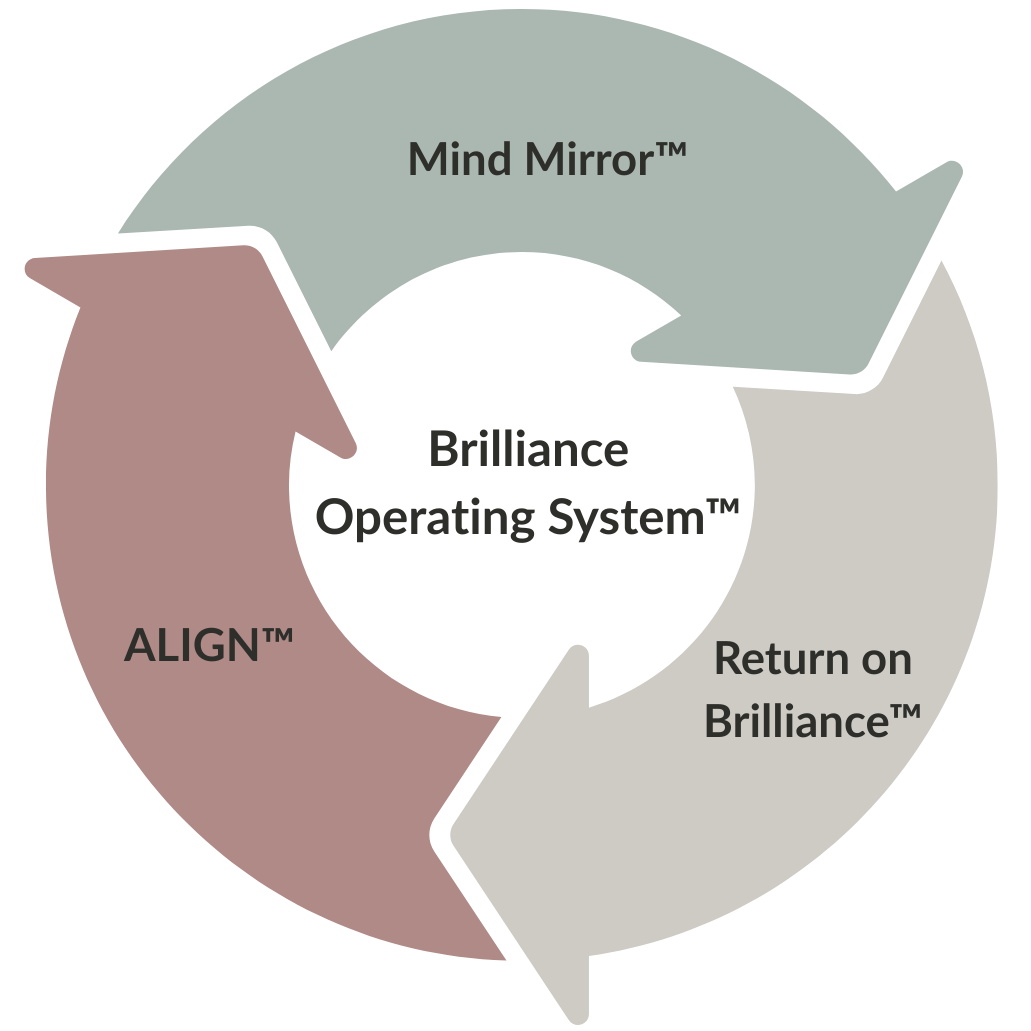
Mind Mirrorᵀᴹ
Pattern recognition at the internal operating level
Recognize the internal patterns shaping decisions, pressure, and effort beyond conscious awareness.
Return on Brillianceᵀᴹ
Results without over-effort
Optimize results by recalibrating the relationship between effort and internal congruence: your Brilliance Quotientᵀᴹ (BQ).
ALIGNᵀᴹ
Sustained leadership under complexity
A grounded framework informed by cognitive, emotional, and adaptive systems that stabilizes how responsibility, decisions, and pressure are carried as complexity compounds.
“I was overcompensating at work — stretching myself thin and leading from urgency rather than trust. While it led to promotions, the pattern was unsustainable.
Through my work with Lauren, I unlearned the behaviors and mentalities shaping how I carried responsibility. I now lead from a place of calm, clarity, and confidence rather than fear. Decisions feel cleaner, work feels more manageable, and my leadership is far more intentional.
Internally, I’ve gained clarity, confidence, and stronger boundaries. Externally, that’s shown up as better decisions, better balance, and more effective leadership.”

Victoria Kiss
COO, CloudPaper
The Executive Recalibration Room
Private 1:1 executive recalibration
Three months · Weekly sessions
This container is designed to help leaders carry less internally so your ability to lead becomes increasingly effortless as complexity rises.
Using my proprietary Brilliance Operating System™, together we:
identify the internal strategies currently driving pressure and load
examine which patterns are creating unnecessary friction
recalibrate how your system processes responsibility, uncertainty, and demand
restore clarity, capacity, and internal efficiency
This isn’t about scaling back your success or lessoning your impact.
It’s about carrying leadership differently — with less internal pressure and greater precision as complexity rises.

If this resonates…
You know the demands of your role and the environment you’re operating in aren’t likely to get calmer, simpler, or slower as we move into 2026.
The real question is: how do you want to operate within it?
This is an opportunity to step back and look, honestly, at your bandwidth, capacity, and energy — and at the internal operating patterns you’re leading from as demands have compounded.
Not to judge them.
Just to see them clearly.
This isn’t about doing more.
It’s about carrying less internally — so you remain effective without running on empty as pressure and complexity increase.